Sustainable Wearable Sculpture by Elisa Rosales Juega
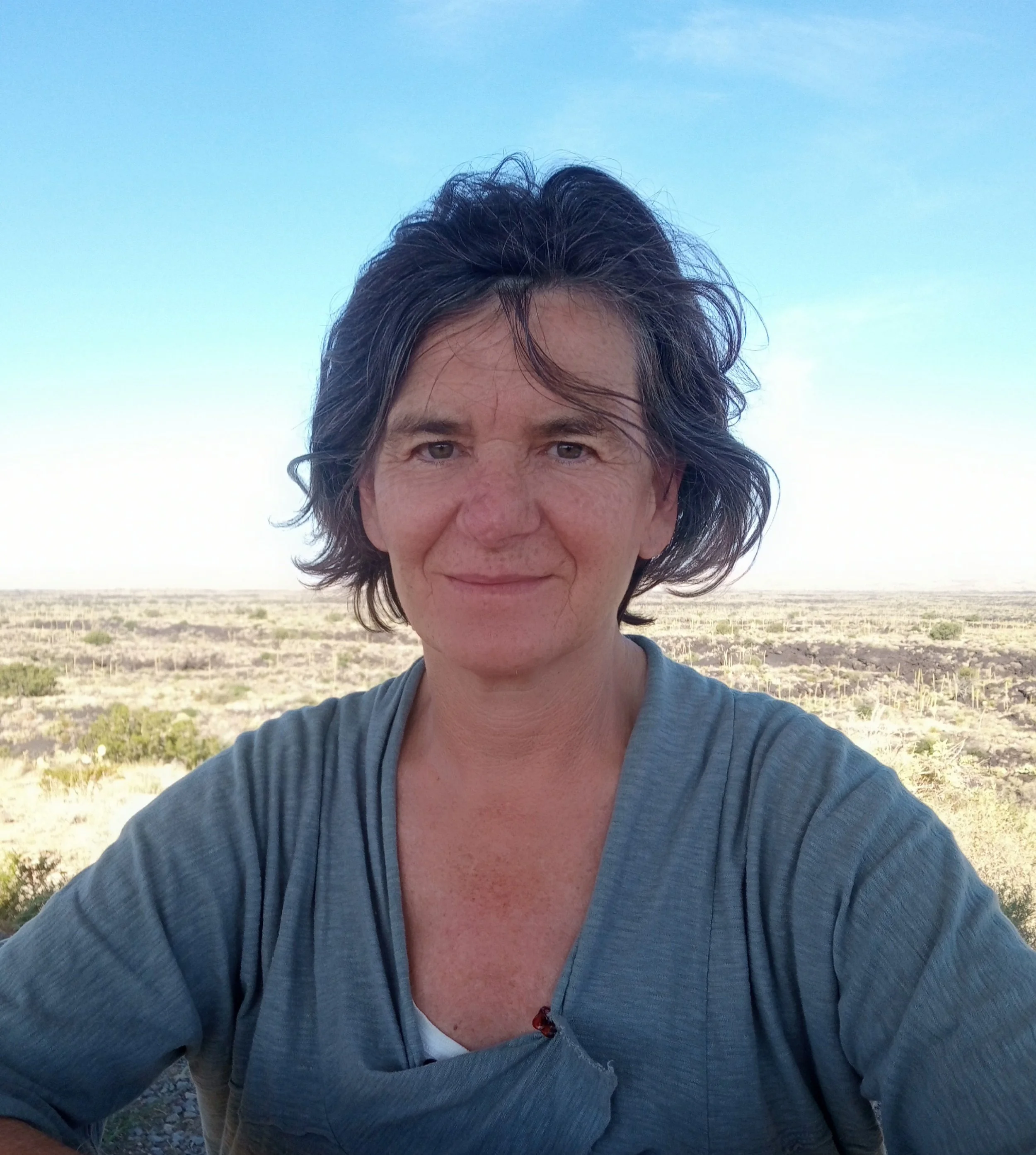
Elisa Rosales Juega, Jewelry Designer
Jewelry by Elisa Rosales Juega
I understand jewelry as wearable sculpture and I am open to the use of any material. From this perspective, the possibilities of creation are infinite and the field of jewelry making is much more fun than ever imagined.
For the last 10 years I have been extensively traveling by motorcycle in South America, Mexico, US, Europe, and Turkey. My jewelry is inspired by the beauty of places and people I have experienced during my motorcycle journeys and by the materials I have found along the way
I am originally from Spain. I moved to USA in 1986, to Syracuse, NY, where I got a Ph.D. in Spanish Literature, and then worked as a university professor for 20 years. I retired early from NAU and moved to Buenos Aires, Argentina, where I took my first class on contemporary jewelry...
1. From Scholar to Maker
You came to jewelry after a long academic career and after traveling extensively by motorcycle. Can you share what drew you from literature and teaching into contemporary jewelry, and what that transition opened up creatively for you?
After 20 years of teaching Spanish language and Literature at the university level, I felt a growing need to move beyond words. I also grew a feeling of distrust toward language and words. You may say whatever you want about yourself but there is a truth about yourself that does not need words to be expressed, that shows up in the way you breath or in the way you conduct yourself in life, and that oftentimes it is obscured by the words you use.
I decided to retire from the NAU and moved to Buenos Aires Argentina. First came motorcycle travelling. No more reading. It was a time to see the landscape with your own eyes, to test your physical and mental endurance, to relate directly with people and things, to live on the road for periods of 4- 5 months. Riding became a practice in presence.
Back in Buenos Aires I gravitated toward acting training because it gave me the opportunity to use the materiality of my body as an instrument. And it was by chance, that one of my classmates, showed me pictures of her jewelry work. It was unlike anything I had seen —expressive, poetic, unconcerned with traditional hierarchies of material and form. I loved it at once and I started taking classes. This was exactly what I was looking for, the possibility of creating poetic objects with my hands.
2. Reclaimed Materials & First Experiments
Your Enviro Earrings are made from recycled aluminum bottle caps—an unconventional and powerful material choice. How did you first begin experimenting with aluminum caps, and what challenges or surprises did you encounter in those early explorations?
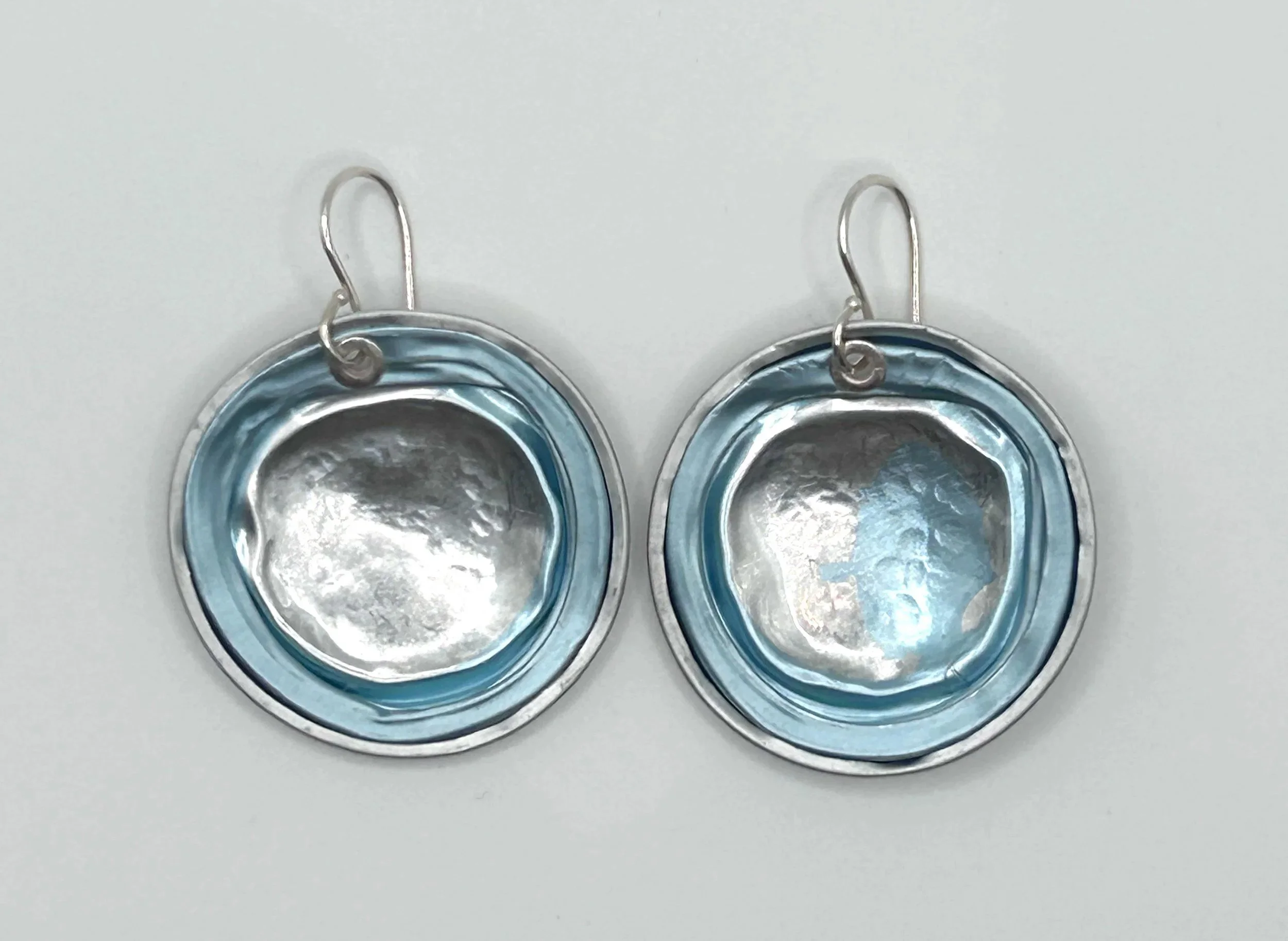
Enviro Earrings by Elisa Rosales Juega
It is hot and dry in the Flagstaff summer, and I drink a lot of sparkling water, especially Perrier. After recycling the bottles, I was left holding the small, golden aluminum caps, struck by their quiet beauty. I began to wonder whether they could become jewelry.
When I started experimenting in my studio, I noticed their resemblance to ancient, hammered gold and silver earrings. I realized that preciousness is always relative — those early adornments were precious in their time, and these aluminum caps can be precious now. It depends on what we choose to value.
I began with gold and silver-toned caps, but soon friends started collecting and donating them to me. An unexpected spectrum of colors and printed designs entered the studio. Each new cap presents both a challenge and an invitation — its color or graphic detail suggests a different direction.
Now, the arrival of a cap I have never seen before is the most exciting moment. It asks: what can I become?
3. Jewelry as Engineering & Movement
There is a strong sense of structure, balance, and movement in your work—almost an engineering quality in how the pieces are constructed and how they move on the body. Can you speak to your design process and how you think about connection, mechanics, and motion when creating your jewelry?
When I work with found glass, everything begins with the fragment itself — its shape, thickness, and the quiet drama it carries. My control is minimal. I clean it, sand its edges, and listen to what it suggests.
With the piece resting on paper, I draw lines of tension and connection. I search for a structure that will hold the glass without enclosing it. The intention is not to confine, but to support — to create a framework that allows it to breathe and to move.
Movement is essential. I want each piece to respond to the body, to shift subtly as the wearer moves. Balance and suspension emerge from careful attention to weight distribution and mechanical connection.
I prefer cold connections — retainers and rivets — rather than soldering. By keeping the mechanics visible, the construction becomes legible. Nothing is hidden. The engineering is not separate from the aesthetic; it is part of the language of the work.
The result is minimalist and functional, yet transparent in its making.
4. Found Beauty & Shipwreck Treasures
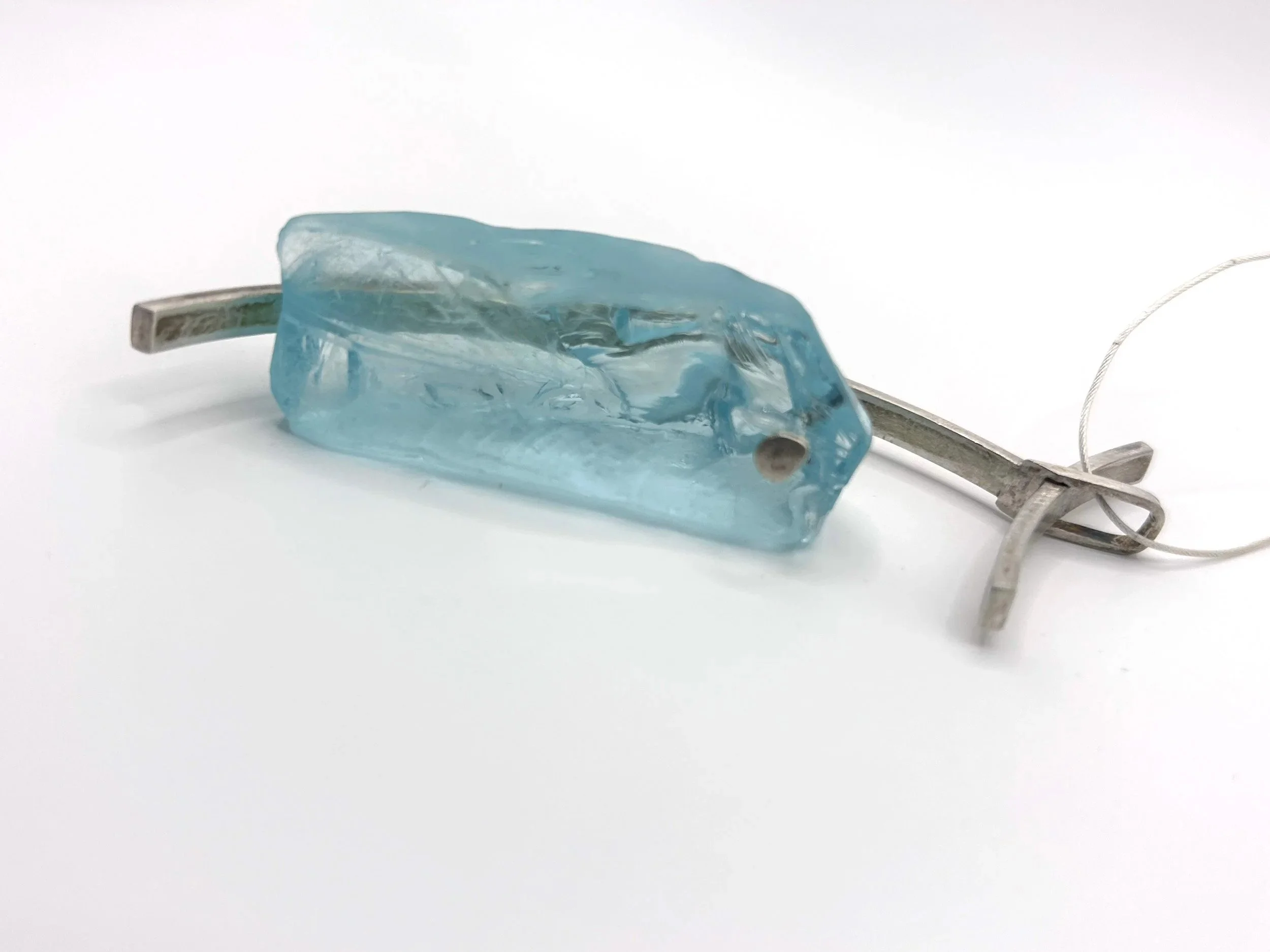
Tail Wind by Elisa Rosales Juega
Shipwreck Treasures began with a single shard of glass found in Buenos Aires and grew into a collection gathered across continents. What draws you to found materials, and how do place, memory, and discovery influence the stories each piece carries?
Found materials feel like a gift from the universe — an unexpected gesture. They are like the wink of an eye. In that brief moment of recognition, a line of communication is drawn between me and the object. A wordless conversation begins.
When I find a shard of glass, I am aware that it has already lived another life. It has traveled, broken, been carried by water, shaped by sand, touched by time. I am not its author; I am its next listener. The studio becomes the place where that conversation continues.
Discovery is an act of attention.
My work becomes a meeting point between chance and intention, between what was found and what is made.
5. The Future of Materials & Meaning
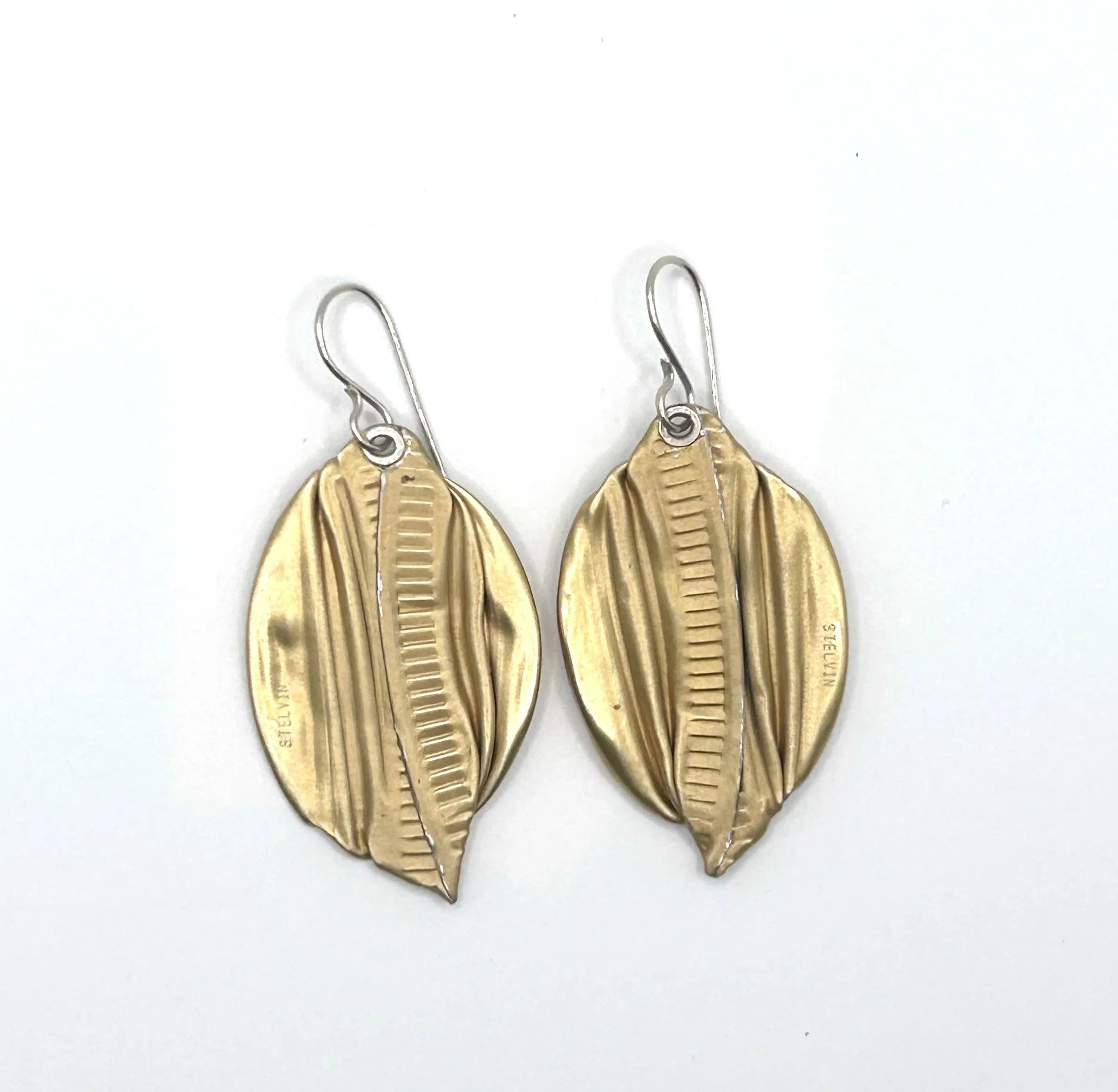
Enviro Earrings by Elisa Rosales Juega
As the cost of traditional jewelry materials continues to rise and environmental concerns become more urgent, how do you see the future of material use in jewelry and art? What possibilities excite you, and what values do you hope makers and wearers carry forward?
We cannot remain bound to inherited traditions without questioning them. At some point, someone decided that the ultimate symbol of love must be gold and diamonds — and a powerful marketing narrative turned that idea into cultural truth.
Today, we have access to information about the environmental damage and human exploitation tied to many of those materials. With that awareness, the question becomes not only what we wear, but what we are willing to endorse by wearing it.
I believe the future of jewelry lies in meaning rather than market value. Materials do not have to be rare to be precious. They become precious through story, memory, and intention. A fragment of glass shaped by the sea, a piece of metal carried through time, an object held onto for years — these can hold more emotional weight than a flawless stone.
In my commission work, I see this shift already happening. People come to me wanting to honor love, loss, or transformation with something deeply personal — a memento that carries their own narrative. It may not be conventionally valuable, but it is profoundly meaningful.
What excites me about the future is this movement toward consciousness and authenticity. I hope makers continue to question inherited hierarchies of value and explore materials with integrity and imagination. And I hope wearers choose pieces not because they were told they should, but because the object resonates with their own story.