Shareholders: A Conversation with David Lash
There are paintings that ask you to stop and look. And then there are paintings that ask you to stay a little longer.
Shareholders, the current exhibition at The HeArt Box, does both.
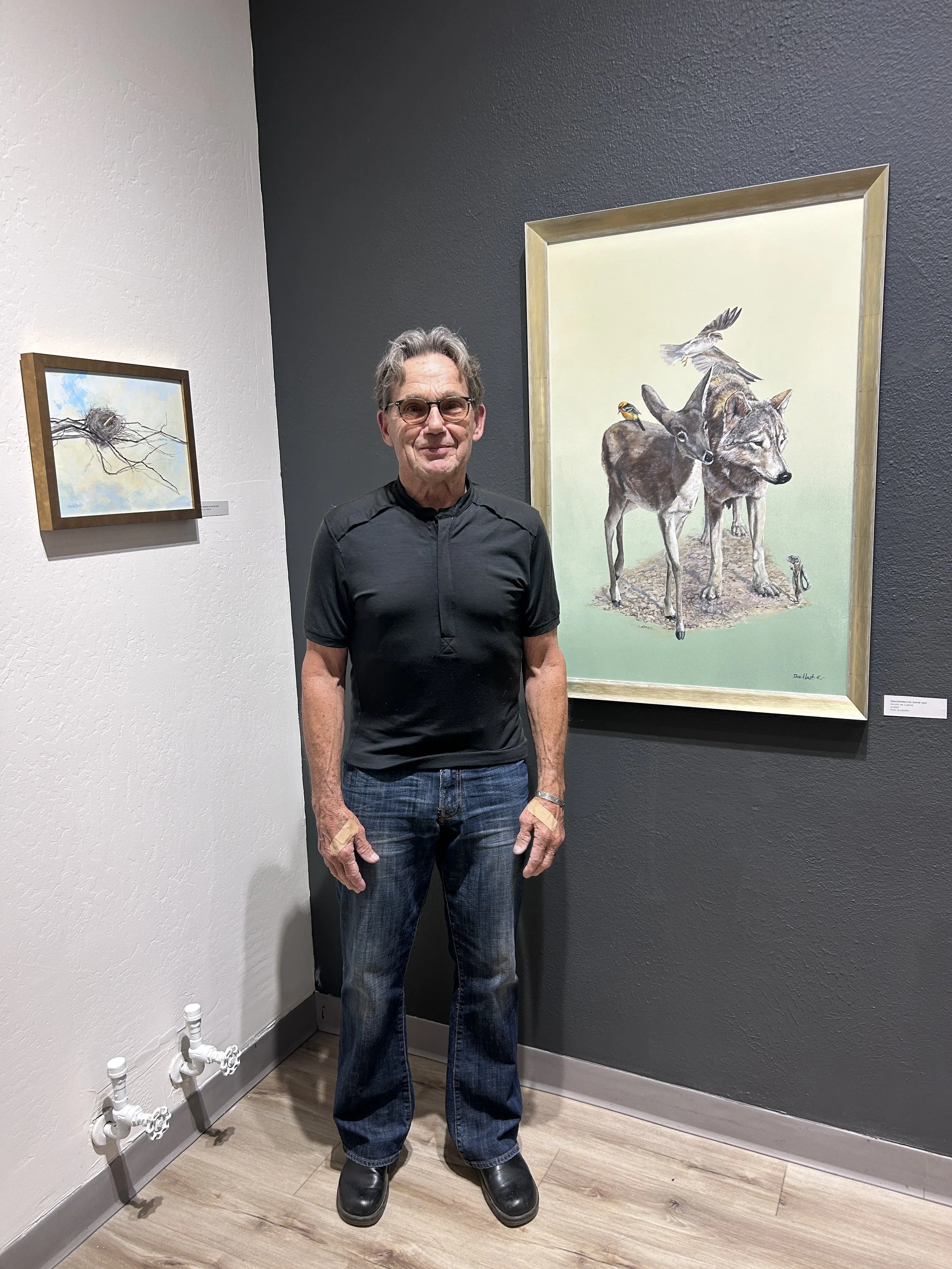
Artist, David Lash standing with Shareholders
On Friday evening, during our October ArtWalk opening, we gathered with artist David Lash to celebrate this body of work. Throughout the evening, I watched people pause in front of the paintings, lean in, ask questions, and enter into conversations that went far beyond simply talking about what was on the canvas. That felt especially fitting for this exhibition, because David’s work doesn’t tell us what to think. It asks us to look more closely and consider what we bring to the experience ourselves.
In Shareholders, Lash invites us to consider the animals who inhabit the Colorado Plateau alongside us—and what their place in our shared landscape might mean as we continue to shape the future of the land.
The four central paintings portray wildlife with remarkable sensitivity and quiet power. David is an extraordinarily skilled painter. His animals are rendered with incredible detail and tenderness. They feel present. Alert. Individual.
And they seem to be looking back.
The oldest voices of the Colorado Plateau are its native animals. Do they deserve consideration when we create land policies? What happens when development, recreation, conservation, and human desire intersect with the lives of beings who have no voice in those decisions?
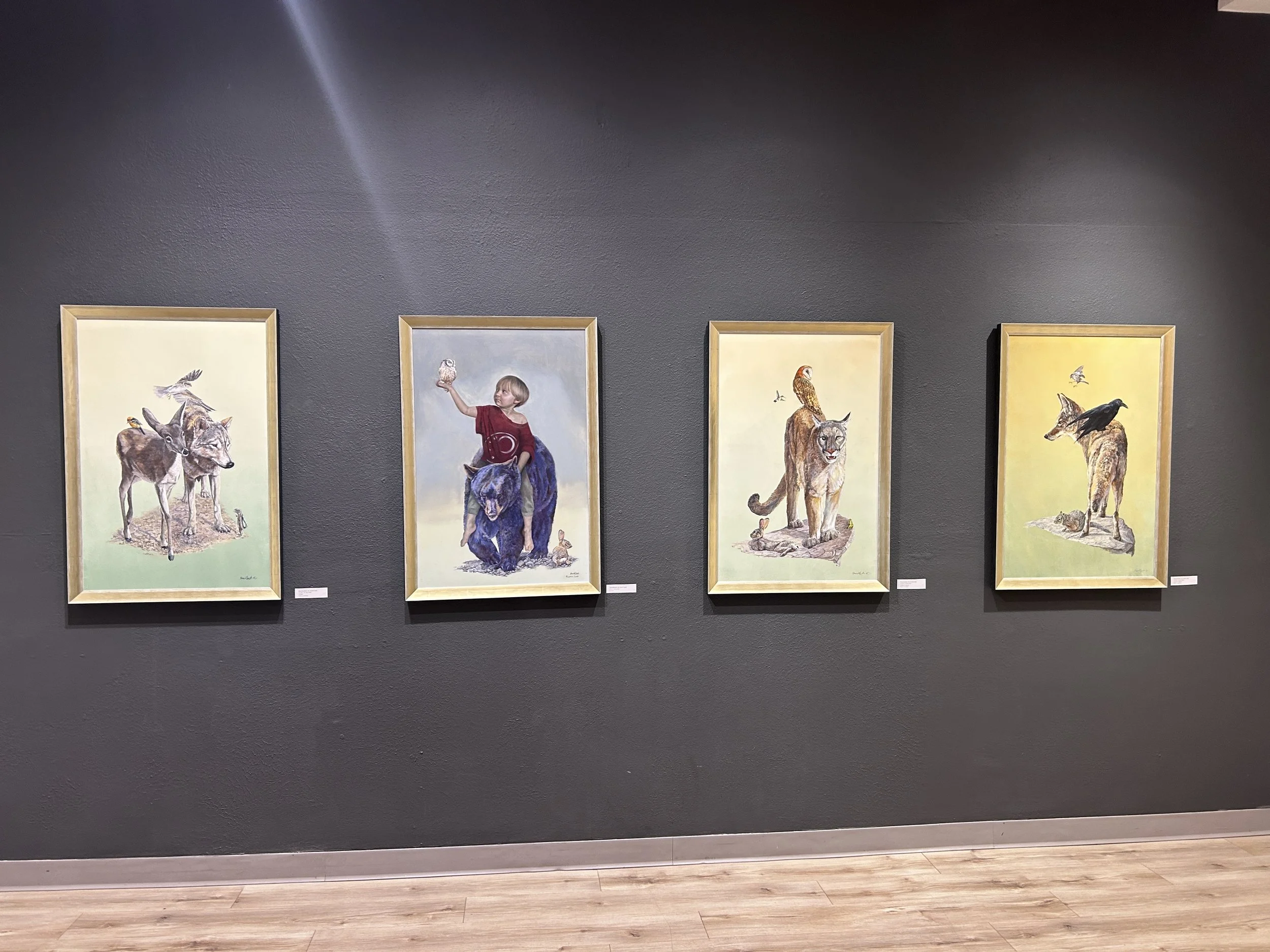
Shareholders by David Lash
These paintings don’t answer those questions. They simply place the questions in front of us.
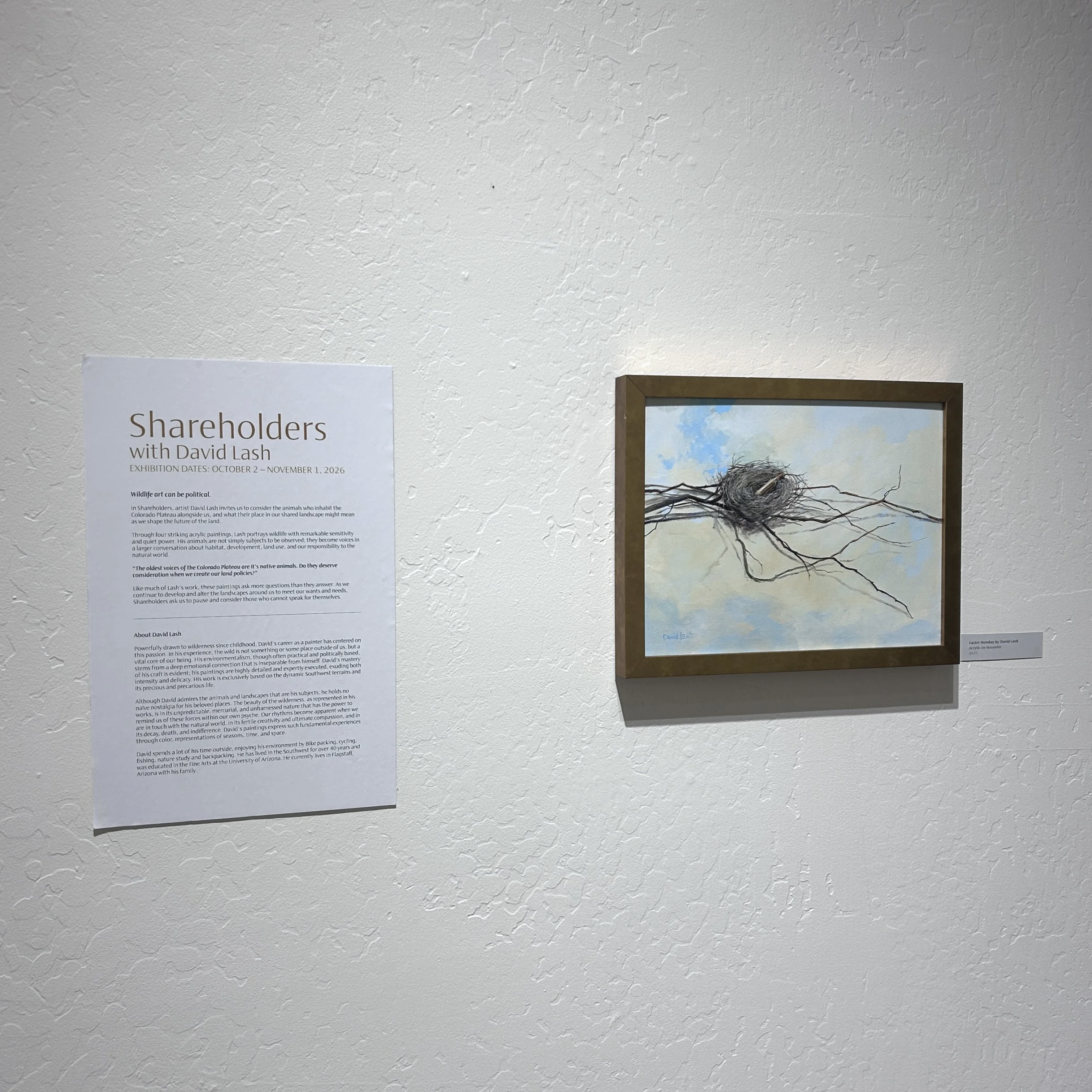
Alongside the four central wildlife paintings are three works that move more directly into political and social territory. Conspiracy of the Game depicts two wolves and a trap. The Heaven at Our Feet asks us to consider the choices we are making for the future of the Earth. And in Easter Monday, a bird’s nest holds a bullet—a quiet but striking contrast between the peace, beauty, and spirituality we celebrate on Easter Sunday and the violence we so quickly return to on Monday.
One of the things I appreciated most about Friday’s opening was hearing David talk about how meaningful it is for him to show this side of his work. His wildlife paintings are often seen primarily for their beauty and craftsmanship, and understandably so. They are beautiful. But David’s work carries something beneath that beauty—a deeper concern for the land and the lives that inhabit it.
He doesn’t get many opportunities to show the more political and controversial pieces.
I’m grateful that The HeArt Box can be a place where he can.
David has spent more than 40 years living in the Southwest, and his relationship with this landscape is not an abstract one. He spends his time outside—bikepacking, cycling, fishing, backpacking, and studying the natural world. His environmentalism grows not only from politics or environmental advocacy, but from a deeply personal relationship with wilderness.
As he writes, the wild is not something outside of us. It is a vital part of our own being.
That idea seems to run quietly through Shareholders. Perhaps when we look carefully at the animals around us, we’re also being asked to look at ourselves: our choices, our assumptions, our sense of ownership, and our place within a much larger living system.
I asked David to share some of his thoughts about the exhibition, his relationship with wildlife, and the role of art in creating these kinds of conversations.
A Conversation with David Lash
You’ve said that you believe art is political. What do you believe wildlife painting can do that words, activism, or environmental advocacy sometimes can’t? And what is your intention when you put these animals in front of us?
Picture this: a painting on the wall, hundreds of viewers. One individual is moved to tears, while the masses never even acknowledge the work. Some look with their eyes and others see with their hearts. I’ve often thought it is what you, the viewer, bring to a work of art that makes it Art.
The same can be said of your response to animals. A person’s knowledge can shape their opinion, and like art, an open and inquisitive mind might lead to a deeper understanding and value of an animal.
You may have come to the gallery to see my art, and for that I am truly grateful. I am in no way responsible for your response.
You grew up around hunting, and you’ve described the last animal you shot as a profound experience that changed something in you. How has that history—and the decision to stop hunting and become vegetarian—shaped the way you see animals and the natural world, and ultimately the way you paint them?
Not finding much challenge in hunting with a gun, I took up archery. Using what today is considered primitive archery—a recurve bow—my kill range was not more than 25 yards.
Being so close to the animal I was attempting to kill, I could sense the wild vitality of a unique individual. The spark of life within me, is it not the same as it is in any other animal?
Examining my motives, I came to the conclusion the thrill and ego affirmation did not justify the taking of a life. Shamefully for me, hunting became nothing more than killing animals for recreation.
If someone walks into this exhibition knowing nothing about your ideas, and walks out carrying one thought, question, or feeling with them, what would you hope that is?
How has the betrayal of science and reason influenced our political “leaders”?
There is something wonderfully unresolved about Shareholders. David gives us beautifully painted animals, but he doesn’t give us easy conclusions. He gives us room to look, to question, and perhaps to reconsider our relationship to the living world around us.
For me, that is part of what makes exhibiting art meaningful.
A gallery can be a place to admire beautiful objects. But it can also be a place to have a conversation we might not otherwise have. It can be a place where we encounter an idea that challenges us, or a perspective that makes us uncomfortable, or simply a question that stays with us after we leave.
Shareholders will be on view at The HeArt Box through November 1.
I invite you to come spend some time with these paintings. Look closely. Notice what you see first—and then notice what you see when you stay a little longer.
And, as David reminds us, pay attention to what you bring with you when you look.
For more of David’s work visit www.davidlash.com